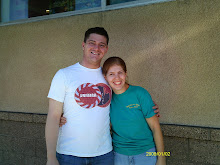
Saturday, November 13, 2010

Traditional Concert


The day after my hike in Chungju with Krista, we met up with more of my friends from the Ju for a relaxing drive into the countryside, freshly-made Indian food from Seoul, and a quiet concert in the foothills surrounding the sprawling city. The concert was put on by a friend of Matt's who operates a school out of a traditional house and hosts the event every year to raise money for his students. He also sells homemade preserves, sauces, and gently used items as part of the event to supplement the income from the concert.

To my surprise, dozens of people were present that day to sample the musical and culinary cuisine, including foreigners I didn't recognize. I tried pointing them out to Krista, but ended up with egg on my face.

"Hey look," I nodded to a couple with lighter hair and skin than the surrounding Koreans, not four feet from where they sat. "Here are some waegukins we don't know." It was an assumption dangerous to make in such a tight-knit community like Chungju.

"I know those waegukins," Krista commented with conviction.

I gulped self-consciously as, at that moment, the couple nodded their greeting to my friend. "Hey Krista," they waved.

"Hey," she called back and volleyed conversation back and forth for a few moments.

Oops.

As the crowd waited for the food to be ready, different stations throughout the compound were set up for amusement. In one booth, girls were making beaded cell phone charms and in another, traditional Nepalese games were being played. Krista and I tried our hands at playing one of the games with Moon Hae, my Canadian friend Jason's wife, and a group of her friends. The object of our chosen game was to get all three of your team's coins from one end of a string of shells to the other. I could see this as being a successful pastime for hotter, dryer climates like those in the Middle East: It looked like something nomadic tribesmen might enjoy, portable as it was without needing the use of a gameboard.

The game was played by first rolling dice in a small wooden cup, and the outcome of the roll told you how many shells to move. You then grabbed your alloted handful, scooted them over, and nestled your coin safely amid the other shells, to repeat your success the next round. It was none too easy, however, because your oponents could, in persuit of the same goal, usurp your coin and place it back at the start of the shells. Competition was so intense that when Jason came to tell us lunch had been served, we couldn't leave until the game was finished and the winning team declared.

After a meal of fresh nan and spicy Indian curry, we sat down in the courtyard of one of the traditional houses on the compound to enjoy the musical delights of my friend Anna and another talented instrumentalist. Anna first played soothing Hindi music for us on her sarangi, a classical stringed instrument from India that sits on your lap and is played much like a dulcimer. She then taught us to sing a song in Hindi using cards in English and Korean displaying each vocal note. The final performer for the night was a multi-talented, multi-intrumental musician who wooed the gathered crowd with exotic notes sounds from far away places, whiskingus away to Africa on the notes of his whimsical song.

All in all, it was a fun time with my friends from Chungju whom I rarely get to see these days. The cuisine was spicy yet satisfying, the music entertaining, and the company enjoyable--a truly beautiful afternoon.

~~~~~


Snippets of a traditional house: Its walls and windows are made of durable hanji, the traditional paper product that Korea is famous for.

My friend Krista beading a cell phone charm: Since my phone has no hook on which to hang such beauty, the one I made has become a camera charm instead.


Traditional Nepalese games before dinner: I played the one pictured last.


Mmmm, fresh nan, the bread of the Middle East: Here, the baker loosely fits the thin dough over a hard round disk resembling a spounge and slaps the dough onto the inside walls of the stone oven, what looks like an electric kiln. The bread comes out looking very much like a thick tortilla and tastes like a pita.


Here, ladies wash the dinner dishes Korean-style, squatting outside near a spigot and a large vat of dirty plates and cups.

This is my beautiful friend Anna and her Korean beau. She showcased her musical talents on a sarangi at the concert later that day.


This was the final act of the afternoon, a rather gregarious Korean who entertained us with his many strange instruments.

Sunday, November 7, 2010

Ladies and Gentlemen, this is Chungju


*Saturday, October 30, 2010*
As the days in Korea turn colder, one of the things I have decided to do with my weekends has been to explore the nation's grand outdoors before winter's icy grip seals it into a snowy, "frozen tundra"--to borrow an oft-repeated phrase from Andy. Two weekends ago, I had an opportunity to do such exploring around one of my favorite places in the country, Chungju-si, with Krista. Through the taxi's window I watched the sun rise beind me over Dongtan's colossal skyscrapers as I rode toward the bus terminal, excited at the prospect of another day of adventure in my Korean "hometown." Come what may, I knew it would be nothing if not unexpected and exhilarating.

Krista and I had plans to take the river ferry from Chungju Lake to Danyang, a beautiful nearby tourist city, that morning. As the only available tickets to our destination were for the last voyage of the day--scheduled to embark at three p.m.--and we had gotten to the docks around 10:45, it would have been a four-plus hour wait just to get on the boat. We decided, instead, to take the ferry around the lake, joining eager Koreans on the deck of the ship to shiver in piercing autumn wind and admire the view. It was a decision which, as well as being eight thousand won cheaper, proved to be equally as picturesque as our original plan; it even allowed us to get back to the dock hours earlier than we were hoping. With time to spare that afternoon, we found a hiking trail that we hoped would be a shortcut to a statue park one and a half kilometers up the road, and decided to check it out.


In Korea, however, as many a foreign naturalist soon discovers, trails are never shortcuts to greater ends. What Krista and I stumbled upon was an ascent up a small mountain that I'm sure would have rivaled any that Brandon had trekked in this country. This was no relaxing nature walk! Wearing my newest pair of brown leather walking shoes, meant for clipped steps around city blocks, and one of my loose-knit, dressy sweaters, I soon discovered that I was ill-prepared for the rigors that the trail presented us.


As we set out on the hike, the trail paralleled the road for about fifty meters, then abruptly turned perpendicular and nearly straight up the hill. The earth that marked its existence looked rocky and freshly upturned, a curious fence-like row of ropes and posts lining its left side. The presence of the newly-installed railing should have been our first clue as to the path's actual difficulty. Because they are rare in this country, if you see handrails anywhere in public, you know it's because you need them!


Whatever foothold I found melted away from me each time I stepped down because of my lack of real contact with the rocky terrain; I only hoped Krista didn't have the same issue. We literally pulled ourselves up hand-over-hand using the ropes, due to our lack of traction and the steepness of the climb. At one point as we descended, I was clinging to the rope so much that it almost felt like I was repelling instead of hiking. Each time we reached the end of the railing, what we thought was the top of the mountain proved to be yet more trail. We finally had to turn back two hours into the hike, as we were no closer to the park and we didn't want to get stuck up there past dark.


Panting for breath as we ascended, I told Krista the story of my "hike" up the switchbacks of Emory Peak in Big Bend National Park when I was fifteen. A select few of my youth group, including myself, had been asked to go on a leadership training camp-out in the remote desert region of West Texas, the birthplace of the Mexican Sierra Madre Oriental, and the only mountains in the whole state. As my friends and I journeyed to the top of the short peak in one-hundred-degree heat, I began to feel the pain of our exertion almost immediately, even to the point that I feared I wouldn't make it to the top.


They each had tried to encourage me with the assertion to "make it five more minutes." After an hour or so of being told every five minutes that a rest was "just five more minutes" away, I yelled out fiercely, "Don't you ever tell me it's five more minutes again!" The wife of our youth leader and one other friend stayed with me as I grumbled the rest of the way up the mountain, but no told me it would be "five more minutes" after that. In fact, no one else said a word to me. It was all I could do to make it to the top for lunch, and were it not for that same friend, I'd never have gotten down. When I finally reached our campsite towards the end of that day, I never thought I'd actually enjoy another strenuous hike again.


I surprised myself that day with Krista. Each time I thought I was done, I somehow found the strength to keep going. If I felt like my energies were spent and my legs had given in, after a minute's breather and a few well-composed snapshots I was ready to get back on the trail. Krista even noticed my vigor. "You're in shape," she said as I took off to attack another run of still more rope handrails. "You took the lead [at the beginning] and you're still climbing." As I expended energy only to find still more to spend, I had to admit she was right. The hike proved to be challenging beyond what I thought I was capable of and yet I was doing it. Here I was--an overweight, lazy, complaining, whiny-butt teenager just nine short years ago--trudging up a steep hill just for the thrill of the adventure.


We both earned the rewards of our suffering as we climbed further and further towards the tiny summit. Wherever we looked, we could see trees, lakewater, and, in the hazy blue distance, mountains. The scene was breathtaking. This is why the city is my favorite, the reason I come back month after month. Ladies and Gentleman, this is Chungju.


Friday, November 5, 2010

Abdication

Over a fortnight ago, I overheard the vice director discussing a developing situation at school with the other foreign teachers, James and Olga. "I will be conducting interviews this week," I heard him say. "As you know, four people are leaving."

We hadn't had any full-time staff memebers leave since Jack left for America in July; surely he didn't mean Korean teachers were saying goodbye. I interrupted him. "No, I don't know. Remember how you were complaining that no one tells you these things and you have to find them out yourself? No one tells me these things. What's going on?"

"I don't really know what's going on," he said as he turned towards me. "I just know that the director, Vicky, Michelle [Teacher], and Anita are leaving at the end of the month. It will be just myself and Grace."

Had I just heard him right? Did he just say the director of the school was calling it quits? I thought it was the captain's job to go down with his ship!--or hers, in this case. How could something like this actually be happening?

The following Monday afternoon, Director Michelle confirmed the reports I had heard. She pulled me into her office to inform me of her decision. "I have to recover my health," she said somberly. "The [stress of] school is not good for me."

Her statement alarmed me to a degree because I knew she had been pregnant for several weeks by this time. I also knew that she had recently been out of the office for three weeks, after major lower back pain just prior to Chuseok. "And what about the baby?" I asked gently.

"You didn't know? I miss... I missed my baby."

"You miscarried?"

"Andrew [my five-year-old son]," she said wistfully, "always asks about the baby. When the baby gonna come? When I recover, I have to try again."

As our conversation returned to school business, she reassured me that everything would run as normal and that payment would again be on time. "Jackson from downstairs gonna take care of everything," she promised. "If you have any questions, just ask Grace."

To her credit, Director Michelle wasn't actually a hagwon director in the Korean sense--for that would have involved owning the company and investing monies into the wellbeing of the school. If she were merely managing affairs for someone else, as indeed she was, it stood to reason that it was her perrogative to resign from such a position if she so chose. Ownership, it was known, rested solely with a group of men whom I'd never met whose offices were kept downstairs on the third floor. And they didn't seem to be going anywhere.

As I walked into the teacher's room after lunch the day following my meeting with Director Michelle, James and the vice director were again involved in deep conversation. It sounded as if they were intently discussing some pressing manly issue, a dialogue I would have been happily content to ignore. "Did you hear him?" James asked abruptly, breaking me from my thoughts. "He said he's leaving Friday." That was the end of October, just four days away.

It seemed like such a sudden decision. The vice director turned to me to reiterate his argument and vouch for his own defense. He had talked with the owners downstairs that day, he stated, and couldn't get what he needed to adequately perform his position in the company. When he asked for relevant past records regarding the school's performance and student history, for example, he was told to provide them himself.

He spoke too fast even for a native speaker's ears and tangled his sentences into a lumpy knot of incomplete thoughts. Straining to catch his rapid-fire, malformed English, I needed to recap. "Basically what you're saying," I summarized, "is that you feel like you're overworked, underpaid, and have not been given enough of the information you need. You've only been here a month; you have no real investment in this school. There's nothing keeping you here."

Six p.m. Friday evening saw the vice director standing at the elevator with a glass container of hot chocolate mix in his hands, the sum total of all his belongings from the office. I was standing near the water cooler observing him leave. "Bye, Jennifer. See you Monday," he said as a joke. Then he hastily added, "I wish."

If he had wished to remain, he wouldn't have come to the decision he had made on Tuesday, abdicating his own responsibility. "No, you don't," I corrected him in a serious tone. "Anyonghekahseyo." Goodbye.

I thought about these new developments as I rode with James to work on bus 27 one recent morning. I asked him what he thought of the turn of events and he reassured me that he had given his word and committed himself for a year to the school, regardless what else happened; it was still his mind to make good on that promise. As for me, I felt the same. It mattered little who came or who left anymore, I knew. For good or for ill, I had signed on for a year.

Good things have come from our managers' shocking decisions. As of yet, the only two to leave have been the two of them, which helps to maintain at least some sense of normalcy for the kids. We have a new part-time teacher in the afternoons, a woman named Leonice who prefers to be called "Leo," who has taken on the classes that the vice director's absence left unsupervised. And we also have someone occupying the director's office, one of the men from downstairs.

"The new director is the old director," Grace relayed to me. "We don't have the money to hire another [one]. Maybe later we will have the money, but for now we don't."

It feels better this way, to be honest, having the owner be the overseer instead of an uninterested, uninvolved third party. Though something surely can be said of stewardship, it's much more powerful when the proprietor of an establishment comes to set affairs straight. So far, he has been: For the first time in two months, I've been paid on time.

Sunday, October 24, 2010

Sah Kyehjole: Fall

Seasons in Korea are quite distinct from any I have thus experienced stateside. The general climate of the region has often been described by foreigners as having a "switch." No sooner is one season in full swing when, as if by push-button magic, another is rolling its way in. Along with its quickly changing weather patterns, the country also promotes fast-forward life seasons; just as one settles into managing a new schedule, apartment, or friendship, news comes to upset the transient equilibrium so freshly created. With my one-year anniversary still fresh on my mind, I decided to celebrate my time here thus far with a look at the best each season in Korea has to offer.

***

Autumn: Kah-uhl 가을 2009

At the end of October last year, two weeks after my arrival, my then-director took me out for a nature walk around Woraksan National Park to view its famed fall foliage.

My director also liked to take me to outings on Sunday afternoons following church. On this day, he brought me to visit Jungnam Tap, the pagoda marking the spot believed to be the exact center of the Korean penninsula.

Here I am on a blistery November day, in thin hose and knee-length skirt without a proper coat, at the windiest place in Chungju, the Chungju Dam.

These were my co-workers at Learning Well (from L to R): my boss, Josh, and my two American teacher-friends, Andy and Brandon. They truly were a blessing!

Autumn: Kah-uhl 가을 2010


Apple Tree has many activity days for the kids, usually cooking "classes" designed for them to learn to follow directions in English. Here I am explaining how to make sweet peanut sauce, then sampling the kids' enthusiastic work. Some days, it really pays to be a teacher.

This is Rachel (left) and Betty (right), two of the smartest kids at the hagwon. Rachel has since moved on to learning opportunities better suited for her skill in English.


Dressing up in hanbok for fall's climactic celebration, Chuseok, students at the hagwon ushered in Korea's fall season with joy and thanksgiving for past traditions. Here I am with Annie in Korea's finery.


Here in Korea, they put turkey behind bars instead of on their plates. I found this rather hefty fella as we toured the grounds of an arboretum on a recent field trip.

This is K2: (L to R) Christine, Irene, Rachel, Julia, and Elena. I took over teaching them after Jack left in July. They are the smartest kids in our kindergarten and they've become so endearing to me.


This is Grace Teacher--one of my colleagues and my supervisor but especially a dear, sweet friend.

After the arboretum, our students had a chance to make funny, playful hats out of the colorful leaves we had collected. I sure couldn't have found leaves that purty in Texas!


I truly am thankful for all of the many blessings in my life this past year.

Wednesday, October 20, 2010

Mr. Smooth

The week before our hagwon let out for its Chuseok holiday, I learned that a fellow co-worker would not be returning after the first of October. Along with this change, I heard rumors that a mystery person would be stepping in, not to take his place, but to act as the "vice director" of the school. I wondered why we had any business hiring anyone if we couldn't keep the staff we already had. As it was quite out of my hands, however, my job was simply to anticipate his arrival on the 27th of September and welcome him warmly.

On Friday the 17th, a full ten days before scheduled, the new vice director joined us for our hanbok-clad festivities as a way to sample his new working environment. He and the director looked the most well-dressed of all of us that day, when we weren't in our special-occasion gowns. By the looks of his gelled locks, I knew he had to have spent more time sculpting his hair than I did showering and brushing my tresses, combined. Even my best attire still seemed a cut below his collared suits and ties. I could tell his being there would raise appearance standards, at least for myself, significantly. But appearance wouldn't be the only thing he would challenge.

Later that day, the staff and students were gathered in the foyer to commemorate Chuseok by making seongpyeong, a traditional Korean rice dough desert--and I was chosen to lead them in English. In order to make the treat, I timidly relayed, you pinch off a bit of dough, mash it with your thumbs into a circle, and fold sugar-coated sesame seeds into it like a mini-calzone. I awkwardly explained the steps of our activity and clumsily folded my "masterpiece" into something akin to a tiny open clamshell. It was just after this that teachers stepped in to show small groups of students how it really should be done. The vice director quipped that he used to make this all the time as a kid and expertly reached down to help the PK kids in front of him.

As soon as the bowls of filling were emptied and all the dough had been pinched, it was time to sample the students' handiwork. I found myself stuffed with the sweet snack within minutes, as students from all around me held out bits of dough in their tiny hands for me to enjoy. During this small feast, the vice director sauntered over to my edge of the rug, his large hand outstretched: In it nestled a perfectly-shaped fold of white seongpyeong. As I am not one to pass up free food, I took his offering and delightfully masticated its sweet crunchiness; yet, I remained suspicious. "All right, Mr. Smooth," I thought. "What are you up to?"

When he officially started working with us, the attention I noticed from the first day didn't seem to go away. He didn't act the role of a boss towards me, so far as I could tell. I felt, instead, more a sense of being his peer than his subordinate, as he would hi-five me in the hallway and drop the respectful title of "Teacher" after my name. I knew we were very close in age and season of life, which might have accounted for the lax. It wasn't until a week after he started that I was surprised to find out he was married, information that threw his conduct into further mystery.

The two of us were accidentally alone in the teachers' office one day as I gathered supplies for my next class. The bell had already rung (five minutes early, to my credit) and I was the last staff member heading to her students. "Teacher Jennifer," he said as my heart pounded. I could already hear his grueling questions about why I was late.

"Why are you so beautiful?"

Pardon me? D-did I just hear what I thought I heard? Should words like that have been coming from my boss? "I don't know why," I quipped nervously. "Ask Jesus."

"Jesus?" he offered skeptically. "I don't know His phone number."

"Don't worry," I said with conviction as I left the room. "He doesn't need one."

Nerve-racking enough as the conversation was, that wasn't the end of them. Two Fridays ago, I spent most of my time at school suffering from sneezing fits and an itchy nasal cavity, apparently due to whatever smoggy gunk had been floating through the air that day. Thankfully, however, I had the weekend to recover. As I walked into the teacher's room feeling better-rested and with clearer sinuses the following Monday, my vice director had his regrets. "You were sick last Friday," he told me. "I'm sorry I forgot to kiss you before you left to make you feel better." Rather annoyed than simply appalled at his verbal antics, I replied that I was "okay" without it.

Later in the week, our school was scheduled to go on an outing to an arboretum to learn about autumn; the director and vice director were slotted to come with us. In truth, I was disappointed that he had to come along, as I was none too ready to spend copious amounts of time outside with him on a beautiful sunny day. If the vice director came near me, my inclination was not to speak unless spoken to; it's not my habit to make friendly conversation with married men.

I found myself serendipitously walking beside him as we trailed behind a small group of students heading back to the school bus that afternoon. One of the other teachers called out that the boys and girls needed to be holding hands as they walked. "Come on," the vice director said to me, shifting his load to the other hand and grabbing mine. "It's just like when we were kids."

No, it's not just like we were kids because I didn't know you when we were kids! I thought to myself as I wriggled my hand free. "No," I said firmly, elongating my stride several paces ahead of him. Rather than be a source of encouragement, I wanted to make my boundaries absolutely clear.

The dynamic of our working relationship has changed significantly since the day at the arboretum. I no longer sense any sort of interest wafting from him, other than merely filial or school-related. Instead, what I do feel is eagerness to be a team player. Our vice director has had to take on new responsibilities as of late, and he needs all the professional support he can get. It may take all of us to get our school back up to par with the rest of them and it wouldn't hurt to extend the hand of friendship along the way.

He caught me mentally focused as I crossed the foyer to get some water earlier this week. "Don't think too hard about me," he called.

"Don't worry," I called back as I kept walking. "I won't."