Showing posts with label Chungju. Show all posts

Monday, September 12, 2011

P. O. A.

“And I heard another voice from heaven saying, ‘Come out of her, My people, lest you share in her sins and lest you receive her plagues.’ ” Rev. 18:4


“I have a question for you,” he suggested nonchalantly as we steadily hiked up the rocky pathway towards the summit of Woraksan. “What do Christians think about dating non-Christians?”

My heart pounded below my blouse. “I”—gasp—“would”—gasp—“love”—gasp—“to answer that question, Ben,” I told him as my chest rose and fell like a tidal wave. “When I’m not heaving!”

“Okay,” he shrugged as I dutifully trudged on beside him.

It was a beautifully brisk afternoon that May in Korea. After winter had grasped the peninsula in its frigid grip for the previous six months, it felt good to get out into the fresh air and stretch our legs. Ten or so yards below us, our friend Dan was trailing behind without fighting to keep up. I was only so close because of the company.

As Ben and I approached a clearing mere meters from the top of the mountain, I quickly began to realize I wouldn’t be good for the final push up the trail. Not having been on a vigorous hike since our last walk four months prior, I was a worn-out rag doll. I also discovered that 70 degrees was a temperature still too cold for my asthmatic lungs to be sucking in so rapidly. When Dan arrived, I advised the still-energetic Ben that he should probably go ahead without us.

“Be back in forty-five,” Ben breathed as his boot struck the dirt. While we waited for his swift return, Dan and I settled in on the concrete ledge in the middle of the clearing, and thoughts quickly turned to our absent friend.

Dan, a professed believer in Christ, had been watching Ben’s and my interaction the last three months, privy to confessions on both sides of the aspiring relationship. He knew that Ben and I had walked through serious heartache together when a friend of ours had jumped ship early in March. He also knew that we had become each other’s best friends since that time. “The feelings are there,” he affirmed. “All you gotta do is light the match.”

He knew what the Scripture said about not being yoked together with an unbeliever (ref. II Cor. 6:14), and, aware of Ben’s lack of faith in Christ, began persuading me to look elsewhere for romance. In addition to his spiritual reasons, Dan also gave other sound advice as to why Ben wouldn’t be the best choice. “He’s leaving in three months—” he began.

“I’ve thought about that, too,” I cut him off.

“Jennifer! The match has been lit!”

I looked down at my feet as his admonition hit its mark. Even then, I knew something had to be done about whatever it was pumping so loudly in my chest. I quietly took up the rear as we descended the mountain, conviction weighing down my limbs more heavily than my fatigue.

It wasn’t until the three of us waited for the bus back to Chungju that night that I realized the totality of Ben’s numbness to Christianity. He’s clueless, I thought as Dan and I tried to share the gospel with him. Nothing we said seemed to penetrate his blank stare.

“It’s okay to have feelings for him,” Dan later told me at Starbucks. “It’s just not okay to act on them. You need a P. O. A.—a plan of action.” He sat back a moment and then looked pointedly at me. “You can’t come to Chungju.”

Since I had moved into my new place the previous March, I had been to see Ben several times. Once, he came up to help me move my things into the new apartment. Another time, we had met in Seoul for a Costco run. Just prior to the hiking trip, I had come to see him for a national holiday and found myself stuck two hours away from home—overnight. Even if I weren’t in Chungju, I knew the struck match could still light a fire.

Facebook had become the sole means of communication for Ben and me—a quick email here, a short post on his wall there. We had even begun to chat together if the two of us were ever online at the same time. If I were to limit what I “Facebooked” him, perhaps I could put out the blaze before it started. No more random posts on his wall, I resolved; and if I emailed him, I couldn’t say anything that I wouldn’t want others to read. “Jennifer Lowery,” read my status update a week later—“has her POA.”

***

Fast-forward a year and three months to August ’11, a year since Ben left the ROK and nearly four months since I’ve been back myself: I hardly think about him anymore. With Ben no longer in my physical world, my POA is all but a non-entity. I wrote him, though, just to see what he was up to.

“I’m back in Korea,” he answered jovially, “with a job that I’m blessed to have. I’m here in Jeju [Korea’s prized tropical island paradise] and have been back for two weeks now.”

While in Korea, I hadn’t given Jeju a serious thought—but now, it looked so appealing. With my new passport in hand, all I would need to get there was to get my federal background check back from the FBI. Maybe my next job would be on a sub-tropical island only a short flight from Seoul. Then again, maybe there would be another tsunami.

Recently I noticed another of my friends from the ROK online at the same time as I, so I messaged him. “Maddock!” I had met him the September before, just days before he left the peninsula for Argentina. As I chatted with him, I typed in Spanish to help his language acquisition in his newly adopted country.

Estoy tan impresionada con tu espanol, mi amigo,” I wrote him. I’m very impressed with your Spanish.

Y tu tambien,” he volleyed back. And you as well. Despues de once meses, necesito saber ALGO! After eleven months, I need to know SOMETHING!

We must have talked in our respective second language for a half an hour or more. I secretly relished the idea that I could turn off my English for so long—and that he was so impressed with my abilities. “Anyway, Maddock, it was great to catch up and chat in Spanish,” I told my friend at the end of our talk.

“Most definitely,” he replied. “Glad to talk to you… Wish I’d met you earlier when we were both in Korea.”

***

In an online Bible study that some friends of mine and I do together, we’ve been studying the prophecies and parables in Revelation. So far, we’ve made it to Revelation 18, the fall of a harlot named Babylon. “All nations have drunk the wine of the wrath of her fornication,” reads verse 3 (NKJV). Another version calls it the “maddening wine of her adulteries.”

In an effort to allow us to understand these things spiritually, our discipler had us understand them physically first. “What do prostitutes do?” she asked us. “Simply put, they receive seed from many different sources.”

Earlier she had argued that this “seed” represents words. We know from the parable of the sower, for example, that the “good seed” sent out into the field is the Word of God (ref. Luke 8:11). This harlot, Babylon, didn’t receive the good seed—and in fact, has mingled it with the seed—words—she has received from others. The “maddening wine of her adulteries,” suggests my teacher, is her mixed words.

Last week, I began thinking about this harlot in terms of my own fallenness, emotionally if not physically or spiritually. When have I received seed from many different sources? Whom have I prostrated myself in front of? Harlots make themselves beautiful and attractive to their lovers—so when have I played the harlot?

My POA really need not have anything to do with Ben anymore. And it has nothing to do with Facebook, either. Rather, it’s about the heart of my own prostitution. I prostrate myself if I make myself attractive to different men through my words—and if I accept their words about me.

My plan of action doesn’t simply mean not writing something I don’t want others to read; rather, it means refraining from saying something that makes me feel good or attractive to multiple men. If it nets me intentional masculine attention, whatever seemingly innocuous action it might be is wrong.

“I saw what you wrote on Ben’s wall,” Dan told me that day I was with him in Starbucks. “And I thought to myself—what is this girl thinking?! [With your post] you’re saying, ‘Oh, I’m thinking about you. I care about you.’ That’s gonna drive him crazy!”

Men love innocence—they’re drawn to it. And I can’t be so innocent as to think my innocence can do no harm.

Sunday, January 30, 2011

Mounting Sajo

The first time I ever went skiing was in January 2003 with my church’s college ministry for a weeklong adventure in the snow and slopes of Colorado’s famed Durango Mountain Resort. Though I had taken ice skating lessons in sixth and seventh grades, I had yet to master balancing on two thin blades—let alone strapping flat, plastic sticks to my feet and pointing me down a mountain! I was non-too-prepared for the frightening speed I picked up as I barreled down the slopes of the Rocky Mountains that winter. At least with ice skates, you stay on level ground.

Since my terrifying first experience, I have mounted skis four more times: once at Sugar Mountain in North Carolina, and now three times in Korea. By no means am I an expert, but now I consider myself a “comfortable novice”—still a newbie, just a little drier behind the ears. My progress on skis seems a vast improvement since my days at Durango when I was so out of control that I slid up an embankment to kiss a tree with my knee, and so mad at myself for not succeeding that I yelled at my college leader on the mountain for making me take a second ski lesson. Eight years later, I’m still nervous about dismounting the lift, but manage to stay upright far more than I am prone.
Considering my newfound skills in the sport, when Krista suggested we ring in the New Year with an adventure at Sajo Ski Resort near Chungju, I felt I was up for the challenge. She had never been skiing, she confessed, and with my four nearly successful attempts I knew I was confident enough to lead her through the basics. Never would I have thought on the bunnies of the Rockies that one day I could call myself an unofficial ski instructor. My, how my college group would have been proud!

“You put your boots on like this,” I told Krista once we had left my ARC (Korea’s rendition of a green card) and Krista’s camera as insurance for our skis and bibs. I pried open the plastic-coated lip and slipped my foot into a compartment one size too small. It was then that the enormity of the task I had just taken on hit me in the face: As I struggled with my footwear, my mind kept drawing blanks as to how to teach my companion the rules of a sport I barely had grasp of myself. I felt at that moment as ill fit for a ski instructor as my boots had been for my feet.

Returning the shoes for a larger pair, I discovered that the skis given to me weren’t fit correctly to my new set of footwear. As I showed Krista how to attach boot to ski, I stared at the gap on my right that should have been flush. “That’s problematic,” I thought to myself. “I’ll have to go back and have them readjust it.” But since we were so close to the ski lift—and by this time it was already 2:30, with just two hours to ski—I let the matter drop.


The two of us managed to scoot ourselves, cross-country style, from the entrance of the resort to a line for the bunny slope, which was twenty rows thick and three people wide. We chatted amiably while awaiting our turn up the slopes, adding our friendly English to the chorus of pleasant Korean clatter around us. As we stood there balanced on our rented skis, I desperately tried again to remember what came next, dread twisting in my stomach like a writhing snake: Now it was crunch time.

Soon the severity of my boot-ski situation bared its unpleasant head. While trying to show Krista how to “pop” snow off one ski by flipping it upwards, my right ski popped itself off my foot. Conditions only worsened when we caught the lift. Just as the two of us caught the lift up the mountainside, my lose ski popped off again and the Korean manning the ride had to run after us to hand it to me—exactly what I had been afraid of while in line. As there was no way to safely reattach my ski without losing something or falling off my seat, the only thing I could do was hold both poles and ski with one hand and the safety bar with the other. This meant, of course, that at the most crucial stage of Krista’s ski-learning thus far, I would out of commission.

“You have to scoot all the way to the edge of the seat,” I told her as we neared the dismount. “You have to ski down the small slope at the end of the lift.” Krista barely had time to ingest my descriptions before it was time for her to slide down the embankment by herself—and for me to helplessly round the pulley circuit heading back down the mountain.

Jam-shi-man-yo!” I called to the attendants. “Wait!” They hurriedly stopped the lift and quickly ran to my rescue as I sat there panting, mere inches from the slope’s drop-off.

Once on solid ground, I walked my skis close to where another attendant stood helping Krista to her feet. “Never point your skis down the mountain,” I instructed as she gathered her wits. “Always stay perpendicular. The goal is to make a zigzag.”

The ski lift had deposited us onto a small, nearly level feeder slope peopled with Sajo’s beginners, which led to the “real” bunnies—the last leg of an intermediate run higher up the mountain. Within a few feet of each other, Krista and I slowly crept our way from lift embankment to the feeder’s mouth, there to attempt crossing the fast-moving current of intermediate skiers.
This was the other thing I had dreaded while still on level ground: maneuvering into the flowing traffic of the bunny slope. Thus far I had been behind Krista, cheering her on while secretly trying to control my own somewhat uncontrollable skis. If I were going slow enough, and were on a flat enough run, I knew I could keep my speed an even pace. But out in the open, with faster moving obstacles, all bets were off.


“Can you cross over there?” I asked Krista when we had made it to the lip of the feeder; I pointed to an embankment on the far right side of the larger slope.

“You go ahead and I’ll follow you,” Krista replied. Exactly what I had hoped she wouldn't say. At her request, however, I slowly took the plunge.

In the sport of skiing a term is used when a skier falls fantastically down the mountain, leaving a trail of gear and valuables behind him: a yard sale. I was famous for my yard sales at Durango—and this was no exception. I had picked up too much speed and found myself slipping out of control. My rented equipment littered the snow as I tumbled stomach-first one hundred yards down the bunnies. Thanks to my right ski’s gap, it landed several tens of yards above me.

As I was falling down the mountain, Krista courageously tried to follow my lead, met with another fall of her own. I watched from farther below as members of the Korean ski patrol came by one-at-a-time to help Krista back onto her feet. Each in turn silently pantomimed a ski lesson for her: Pull yourself up like this. No, no, don’t pop your ski off. Point your skis like this. “Edg-ee,” one of them had said. Use your edges to turn.


I was feeling less and less like a ski instructor, unofficial or not, the longer I stayed on the mountain. Words continued to fail me and I was unsure how to avoid another demonstration of my limited skills. “I hope my instructions have been helpful,” I told Krista as soon as she rejoined me.

“You just forgot the part about the edges,” she sighed. “You’re supposed to push on your edges to turn.” I nodded my understanding and slowly, quietly, we began yet another descent down the slopes, me trailing behind to help her in the event of another fall.

After another string of falls and subsequent successful attempts to pull her back onto her feet, my pupil stopped. “I’m terrified, Jenn,” she said. She stood there perpendicular to the bunny’s incline, paralyzed in her ski boots.

It was like watching my own thoughts from eight years ago play out on someone else’s lips. “I’m mad at myself and exhausted from all of my falls,” she confessed. “I want to just take off my skis and slide down the mountain.” I told her that she certainly had a right to feel that way, yet needn't give up quite yet. She might not forgive herself if she didn't try at least one last time. Deliberately, she formed her skis into a wide A and started her run.

It was her last run of the day--and arguably the most successful. One hundred yards from the end of the bunny slopes, she took control of her skis and coasted all the way to level ground. Assah! 아싸! I stood on a side embankment watching proudly as she glided safely off the mountain.
Her face was beaming as I approached her moments later, herself exhausted but triumphant. “I’ll do this again in about a month,” she told me. “It'll take that long to fully recover.” Confidently we scooted to the edge of the snow, popped off our skis, and deposited them back with Sajo's attendants. This had been a glorious day.


There was another reason that made the day distinguished: Attempting to ski had been on “The List,” a group of personal goals for Krista to accomplish. It was only after we were tucked safely back in her apartment and I read The List on her wall that I realized the importance of the day. I may not have been the most well-versed ski instructor, but going skiing with her had thus helped my friend fulfill something purposeful in her life. And that felt better than any sort of accolade from friends back home.


Thursday, November 18, 2010

Sah Kyehjole: Winter

Winters in Korea look a lot like they do in Virginia, Maryland, or (as I'm told by friends who are from there) Minnesota and even Idaho--not, however, like they do as far south as Texas. Winters where I come from tend to look a lot more like any normal locale's fall season: a bit nippy, sometimes down-right chilly, and on freak occasions actually below thirty-two degrees. My grandparents, who have been farmers all of their seventy-plus years, think it's a good winter if we get "one good freeze."


As a consequence of Texas' unpredictable climate, I was non too prepared for the bare temperatures I felt as I huddled near the warmish space heater in our closet-like office last year. This, I was to learn, was my first real taste of winter's icy fist, which for the next five months locked the peninsula in what Andy liked to call a "frozen tundra." The first snowfall of the season fell in the middle of the night around November 5, uncharacteristically too soon according to many Koreans, with the last falling sometime mid-April. I returned to Korea from my visit to Texas near the beginning of May to find temperatures had only warmed up to a barely-tolerable, layer-peircing five degrees Celcius (40 degrees F). To my dismay, I still needed a long thick sweater on the first of June.


Being that our hagwon was without consistent heating, equipped with the smallest of space heaters that did little to melt the ice-condensation on the floor or erase the visible puffs of breath from our mouths, I was loathe to move from my chair to the classroom for most of 2009's winter season. Each day as I prepared to leave my apartment, its thermostat always set to 30 degrees Celcius (85 F), I layered stockings over stockings and turtlenecks over longsleeve tees to combat the conditions I knew I would find at school. I was never without one of two knit sweaters and always wore a thin jacket underneath my mother's bulky winter coat whenever I stepped out of doors.

Yet for all my layers, my preparations still seemed inadequate to ward off the grip of Korea's icy winter chill. As a way for me to cope mentally with the incessant cold, the running joke in the office with Andy and Brandon was that they should wake me up in three months. My blunders, however, were never far from scrutiny--and this was apparently no exception. Brandon commented one day upon reflection, "You know, you keep saying March. But what if it's still cold [then]?"


But it just had to warm up by March, I was sure--so sure that as I packed my bags the last weekend of February in preparation for my move to Suwon, I stuffed my mom's big blue ski jacket inside a small box and left it at Andy's house, to be picked up at my earliest convenience. Confessing what was inside the box to Andy while en route to my new home, he offered, "Well you know that was a stupid idea." He proved himself right when temperature dipped low again for one "last cold snap" that week, while I huddled without a proper jacket to wait for the bus.


It was a long, bitter winter for the inhabitants (and transient residents) of Korea's pennisula for 2009-2010, with record-deep snowfall at the beginning of January in Seoul and as far south as Chungju. Yet for all its harsh reality, the season still proved itself to be filled with surprises and adventure. My dad once told me that "there's nothing for you in this season." When I offered that to my friend Anna, she observed that perhaps that means I should just look more closely for ways to enjoy it. Though I think Dad is still right on some level, I'm beginning to appreciate the changes, rhythms, and seasons of the life that the LORD brings. Even bitter ones turn beautiful if you let them.

***

Winter: Kyah-ul 겨울 2009


I had the chance to experience my first real snow last December in a posh eatery on the outskirts of Chungju, on the other side of the Chungju Dam.


For last winter vacation, I was able to take a modest trip around Korea. Here I am en route south to Gwangju to visit an acquaintance on a train that felt, save for hot-hot-hot-hot choc'late, like the Polar Express.


This is Gwen, the woman who saved my luggage. She lives in Gwangju and offered me a place to stay when I came to visit.


This is a group of Korean believers who welcomed me to their church, the foreign new-comer, with open arms. The woman to my left was my translater, the sister of the girl to the right in the foreground. I felt so loved there--and felt the Spirit move so freely--that for a moment I seriously contemplated making the three+ hour commute every weekend just to be a part of their fellowship.


Welcome to Busan: where big city meets Korean small-town country. This eatery in the express bus terminal looked so warm and inviting--and so much like an American diner--that I stopped and ordered a roll of kimpap while pouring over my tourist map to figure out my itinerary for the day.


When I first got to Busan, I found this bloom and remember being amazed that such life could blossom in wintertime. I marveled at its ability to thrive in such harsh conditions.


One night's stay in Busan cost me 60,000 won (about $48), but it was well worth the splurge as I had a plush bed to sleep in, a nice street view, and an actual SHOWER to stand in that didn't leave my bathroom floor and everything left on it sopping wet.


My whole reason for visiting Busan was to pay my respects to the UN Memorial Cemetary to honor my grandfather, who had served in the American Armed Forces and was stationed here in Korea during the Korean War. The row of flags represents the 28 nations who came to South Korea's aid for those three years of open conflict.


This is the traditional house I stayed in during my visit to Jeonju. The place was cozy and the staff was hospitable, with tea brought to my door and traditional breakfast served hot and fresh in the morning.


During my stay in Jeonju, I visited their cathedral and had a chance to sip a cup of fresh dechu tea with a wonderfully sweet woman from their cultural museum. She sat by me, chatting with me and teaching me snippits of Korean as I savored her sweet creation. Among the many Korean teas availible, dechu remains my favorite.

Dal Cheon's Christmas service: Here youths are gathering at the front to read letters written to their parents to thank them for the support and encouragement they had provided throughout the years. Though I couldn't understand much of what was said, the scene itself was very touching.


"Stocking stuffers" given as a Christmas present from Dal Cheon.


Christmas Dinner! After our Christmas Day service at my adopted Korean church in Chungju, Dal Cheon Kam-ri Gyo Hwi (달 천 감리교회), my then-director took me out for ja-ja-meon, a "Koreanized Chinese" noodle dish traditionally prepared by hand (notice the scissors in my director's hands used to cut the noodles; surprisingly, they are quite effective). I had a chance to watch the man in the back make a batch of fresh noodles by wrapping the stringy dough quickly by his wrists like a jump rope and stretching it repeatedly. It was an art quite fascinating to watch.

One of my friend Anna's and my favorite pastimes last winter was skiing; during the season, we went twice. It took me a bit to remember how my feet worked clamped to boards almost as long as I am tall, but once it came back to me I really started to enjoy myself. No, Brenda, I did NOT yell at anyone on top of the mountain. But on the steepest slopeI had yet encountered, I took off my skis, pointed my feet downward, and had the slide of my life!
January 16, 2011 will mark a year to the day that I brought my Frankie-boy to come live with me. He has been such a precious blessing!

The day I got Frankie, Dal Cheon took their youth on an outing to go sledding--and took me with them. As I had yet to experience the joy of tumbling down a frozen slope in style, I gave it a try and had a BLAST!

The boys surprised me with a Paris Baugette chocolate cake in the form of a miniature, edible piano for my birthday. There was so much of it left that I divvied it up into cups and passed its pieces out to all my classes throughout the day. I laughed at having to use chopsticks to eat my treat--until I later realized that it's just the norm in Korea to eat cake without a fork.

Lauren, one of the sweetest office staff members there is to work with in South Korea.

Coming on the 24th of February and just after San Antonio's only real cold snap, my birthday always marks the end of winter for me; this year it marked the end of more than just that. Less than a week later, I said goodbye to Chungju and packed my bags to head north for the coming spring and yet a new life season. But not before being serenaded by the musical talents of Mr. Andy Afternoon Levin: My birthday treat was an evening of tasty shabu-shabu followed up with mouth-watering solos, duets, and a group debut of "Happy Birthday" at the local nuraebang.

Boys and Girls of the Ju, here's to you!

Sunday, November 7, 2010

Ladies and Gentlemen, this is Chungju


*Saturday, October 30, 2010*
As the days in Korea turn colder, one of the things I have decided to do with my weekends has been to explore the nation's grand outdoors before winter's icy grip seals it into a snowy, "frozen tundra"--to borrow an oft-repeated phrase from Andy. Two weekends ago, I had an opportunity to do such exploring around one of my favorite places in the country, Chungju-si, with Krista. Through the taxi's window I watched the sun rise beind me over Dongtan's colossal skyscrapers as I rode toward the bus terminal, excited at the prospect of another day of adventure in my Korean "hometown." Come what may, I knew it would be nothing if not unexpected and exhilarating.

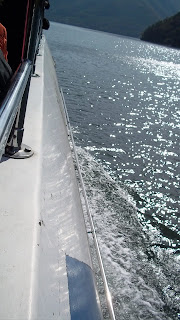
Krista and I had plans to take the river ferry from Chungju Lake to Danyang, a beautiful nearby tourist city, that morning. As the only available tickets to our destination were for the last voyage of the day--scheduled to embark at three p.m.--and we had gotten to the docks around 10:45, it would have been a four-plus hour wait just to get on the boat. We decided, instead, to take the ferry around the lake, joining eager Koreans on the deck of the ship to shiver in piercing autumn wind and admire the view. It was a decision which, as well as being eight thousand won cheaper, proved to be equally as picturesque as our original plan; it even allowed us to get back to the dock hours earlier than we were hoping. With time to spare that afternoon, we found a hiking trail that we hoped would be a shortcut to a statue park one and a half kilometers up the road, and decided to check it out.


In Korea, however, as many a foreign naturalist soon discovers, trails are never shortcuts to greater ends. What Krista and I stumbled upon was an ascent up a small mountain that I'm sure would have rivaled any that Brandon had trekked in this country. This was no relaxing nature walk! Wearing my newest pair of brown leather walking shoes, meant for clipped steps around city blocks, and one of my loose-knit, dressy sweaters, I soon discovered that I was ill-prepared for the rigors that the trail presented us.


As we set out on the hike, the trail paralleled the road for about fifty meters, then abruptly turned perpendicular and nearly straight up the hill. The earth that marked its existence looked rocky and freshly upturned, a curious fence-like row of ropes and posts lining its left side. The presence of the newly-installed railing should have been our first clue as to the path's actual difficulty. Because they are rare in this country, if you see handrails anywhere in public, you know it's because you need them!


Whatever foothold I found melted away from me each time I stepped down because of my lack of real contact with the rocky terrain; I only hoped Krista didn't have the same issue. We literally pulled ourselves up hand-over-hand using the ropes, due to our lack of traction and the steepness of the climb. At one point as we descended, I was clinging to the rope so much that it almost felt like I was repelling instead of hiking. Each time we reached the end of the railing, what we thought was the top of the mountain proved to be yet more trail. We finally had to turn back two hours into the hike, as we were no closer to the park and we didn't want to get stuck up there past dark.


Panting for breath as we ascended, I told Krista the story of my "hike" up the switchbacks of Emory Peak in Big Bend National Park when I was fifteen. A select few of my youth group, including myself, had been asked to go on a leadership training camp-out in the remote desert region of West Texas, the birthplace of the Mexican Sierra Madre Oriental, and the only mountains in the whole state. As my friends and I journeyed to the top of the short peak in one-hundred-degree heat, I began to feel the pain of our exertion almost immediately, even to the point that I feared I wouldn't make it to the top.


They each had tried to encourage me with the assertion to "make it five more minutes." After an hour or so of being told every five minutes that a rest was "just five more minutes" away, I yelled out fiercely, "Don't you ever tell me it's five more minutes again!" The wife of our youth leader and one other friend stayed with me as I grumbled the rest of the way up the mountain, but no told me it would be "five more minutes" after that. In fact, no one else said a word to me. It was all I could do to make it to the top for lunch, and were it not for that same friend, I'd never have gotten down. When I finally reached our campsite towards the end of that day, I never thought I'd actually enjoy another strenuous hike again.


I surprised myself that day with Krista. Each time I thought I was done, I somehow found the strength to keep going. If I felt like my energies were spent and my legs had given in, after a minute's breather and a few well-composed snapshots I was ready to get back on the trail. Krista even noticed my vigor. "You're in shape," she said as I took off to attack another run of still more rope handrails. "You took the lead [at the beginning] and you're still climbing." As I expended energy only to find still more to spend, I had to admit she was right. The hike proved to be challenging beyond what I thought I was capable of and yet I was doing it. Here I was--an overweight, lazy, complaining, whiny-butt teenager just nine short years ago--trudging up a steep hill just for the thrill of the adventure.


We both earned the rewards of our suffering as we climbed further and further towards the tiny summit. Wherever we looked, we could see trees, lakewater, and, in the hazy blue distance, mountains. The scene was breathtaking. This is why the city is my favorite, the reason I come back month after month. Ladies and Gentleman, this is Chungju.